The brain and the eyes work together to create a visual experience. On one hand, the eyes send signals to the brain, which allows it to translate that data into visuals; on the other, the brain sends signals to the muscles attached to each eye, controlling their movements. If anything disrupts these
Read more
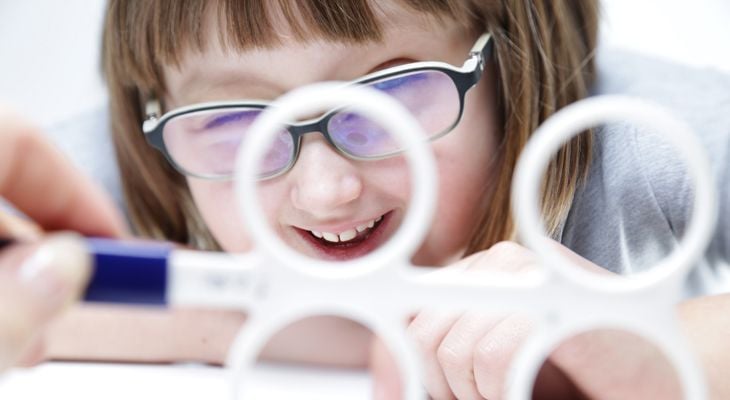
Vision therapy programs are designed to correct complications like astigmatism, wandering eyes, lazy eye or crossed eyes – all of which can affect eye focus, eye movement, visual perception and coordination. With visual therapy, a combination of vision exercises and specialized equipment are used to train the visual system to repair itself, or strengthen itself, so that eye problems can be rectified or diminished enough to improve how the patient views the world and functions in it.
Executed under the supervision of an optometrist, visual therapy is implemented in an office once to twice a week for up to an hour. Exercises and equipment will be personalized to meet the patient’s needs based on the severity of the problem and related symptoms. These components will also be considered when determining how many sessions the patient requires. To accompany in-office visits, the optometrist may also educate the patient on how to perform specific vision exercises at home.
When visual therapy is complete, and all necessary sessions have ended, the patient’s visual skills and capabilities should have improved and any symptoms associated with their eye condition should have reduced significantly. In addition, visual efficiency should have enhanced and the patient should be more efficient when it comes to processing and understanding visual information.
-
Balance Board
-
Corrective Lenses
Corrective lenses are used to correct deviations, adjust focal points or neutralize other anomalies that impact the eyes’ ability to focus an image on the retina. To do this, the lenses must be the correct type and of the right power. Strength – which is expressed as diopeters – relies on the material
Read more -
Training Devices
Visual-motor-sensory integration training uses various devices to appeal to a person’s senses, including touch, sound and smell. This type of therapy is particularly useful in children with autism. Devices may include play dough, rubber toys, weighted bells and blankets, water, rice, sand, beans, musical
Read more -
Cawthorne-Cooksey Exercises
These exercises are mainly used at home and range from simple head and eye movements to performing more complex activities like throwing a ball or focusing on a stationary object while the head is moving. While moving one’s head and tossing a ball sounds easy enough, they are not simple tasks for persons
Read more -
Keep Your Eye on the Ball: How Vision Therapists Use Marsden Balls to Help Their Patients
A Marsden ball might not look very impressive, but this little ball offers big benefits for athletes and children affected by strabismus, ambylopia and other conditions. Marsden ball exercises are just one of the techniques that vision therapists use to help patients make better use of their vision. What
Read more
Locations
Hours
Hampton Location
Monday:
9:00 am-5:00 pm
Tuesday:
9:00 am-5:00 pm
Wednesday:
9:00 am-5:00 pm
Thursday:
9:00 am-5:30 pm
Friday:
9:00 am-5:00 pm
Saturday:
One Saturday per month
9:30 am-4:00 pm
Sunday:
Closed
Zebulon Location
Monday:
Closed
Tuesday:
9:00 am-5:00 pm
Wednesday:
9:00 am-5:00 pm
Thursday:
9:00 am-5:30 pm
Friday:
9:00 am-5:00 pm
Saturday:
Closed
Sunday:
Closed