Automated targets with timing mechanisms not only show the optometrist how the eyes move in the beginning of treatment – when eye problems have yet to be fully addressed – by strategically positioning the targets, but they give weak eyes a necessary workout. By moving the eyes around to focus on
Read more
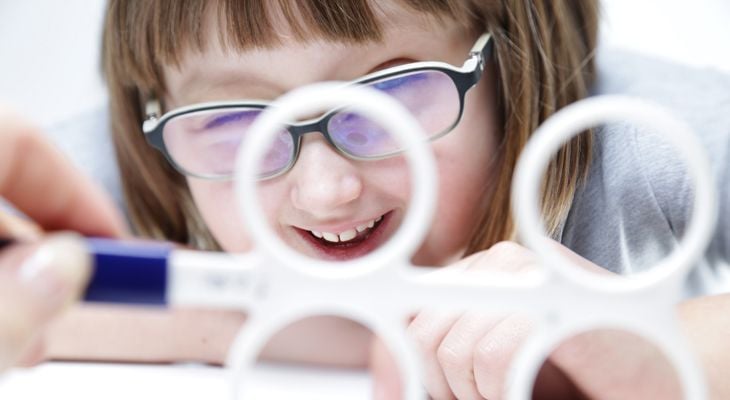
Vision therapy programs are designed to correct complications like astigmatism, wandering eyes, lazy eye or crossed eyes – all of which can affect eye focus, eye movement, visual perception and coordination. With visual therapy, a combination of vision exercises and specialized equipment are used to train the visual system to repair itself, or strengthen itself, so that eye problems can be rectified or diminished enough to improve how the patient views the world and functions in it.
Executed under the supervision of an optometrist, visual therapy is implemented in an office once to twice a week for up to an hour. Exercises and equipment will be personalized to meet the patient’s needs based on the severity of the problem and related symptoms. These components will also be considered when determining how many sessions the patient requires. To accompany in-office visits, the optometrist may also educate the patient on how to perform specific vision exercises at home.
When visual therapy is complete, and all necessary sessions have ended, the patient’s visual skills and capabilities should have improved and any symptoms associated with their eye condition should have reduced significantly. In addition, visual efficiency should have enhanced and the patient should be more efficient when it comes to processing and understanding visual information.
-
Electronic Targets
-
Therapeutic Lenses
Contact lenses, or therapeutic lenses, are thin lenses that are placed on the surface of the eye. While some wear them for cosmetic reasons, their primary function is to correct and improve vision problems related to refractive errors, act as a protective layer in patients with eye injuries, reduce discomfort
Read more -
Filters
Optical filters carefully transfer light in a specific range of wavelengths or colors while obstructing what remains. These dyed plastic or glass devices are placed in the optical path. They are described by their frequency response, and this identifies how the scale and stage of each frequency component
Read more -
Directional Sequencers
This device integrates all of the senses used for learning. It is one of the basic instruments used for visual-motor training, and helps with direction, rhythm, eye-hand coordination, and work and shape recognition. It consists of an aluminum case with illuminated membrane switches organized along a
Read more -
Marsden Balls
Here, a ball with letters, numbers, colors, pictures, or a combination is hung from the ceiling. In activities used to help focus visual attention, the individual may be asked to concentrate on a figure while bunting the ball with a rod, or hitting or catching it with their thumbs, palms or fists.
Read more
Locations
Hours
Hampton Location
Monday:
9:00 am-5:00 pm
Tuesday:
9:00 am-5:00 pm
Wednesday:
9:00 am-5:00 pm
Thursday:
9:00 am-5:30 pm
Friday:
9:00 am-5:00 pm
Saturday:
One Saturday per month
9:30 am-4:00 pm
Sunday:
Closed
Zebulon Location
Monday:
Closed
Tuesday:
9:00 am-5:00 pm
Wednesday:
9:00 am-5:00 pm
Thursday:
9:00 am-5:30 pm
Friday:
9:00 am-5:00 pm
Saturday:
Closed
Sunday:
Closed